Watch first
OSI Application & Transport Layers (FREE CCNA EP 5)
Video credit: NetworkChuck
Watch on YouTubeTCP & UDP (Day 30)
Video credit: Jeremy's IT Lab
Watch on YouTubeClients, Servers, Protocols & Ports (Video #4)
Video credit: David Bombal
Watch on YouTubePlain-English explanation
TCP is the careful courier: three-way handshake, sequence numbers, acknowledgments, retransmissions, and flow control. It guarantees ordered delivery — at the cost of overhead and delay.
UDP is the postcard: connectionless, minimal header, no guarantee of delivery or order. Fast and simple — perfect when late data is useless (live voice/video) or when the app handles reliability itself.
Both use 16-bit port numbers (0–65535) so multiple applications can share one IP address. A socket is roughly IP + port + protocol.
Deep dive
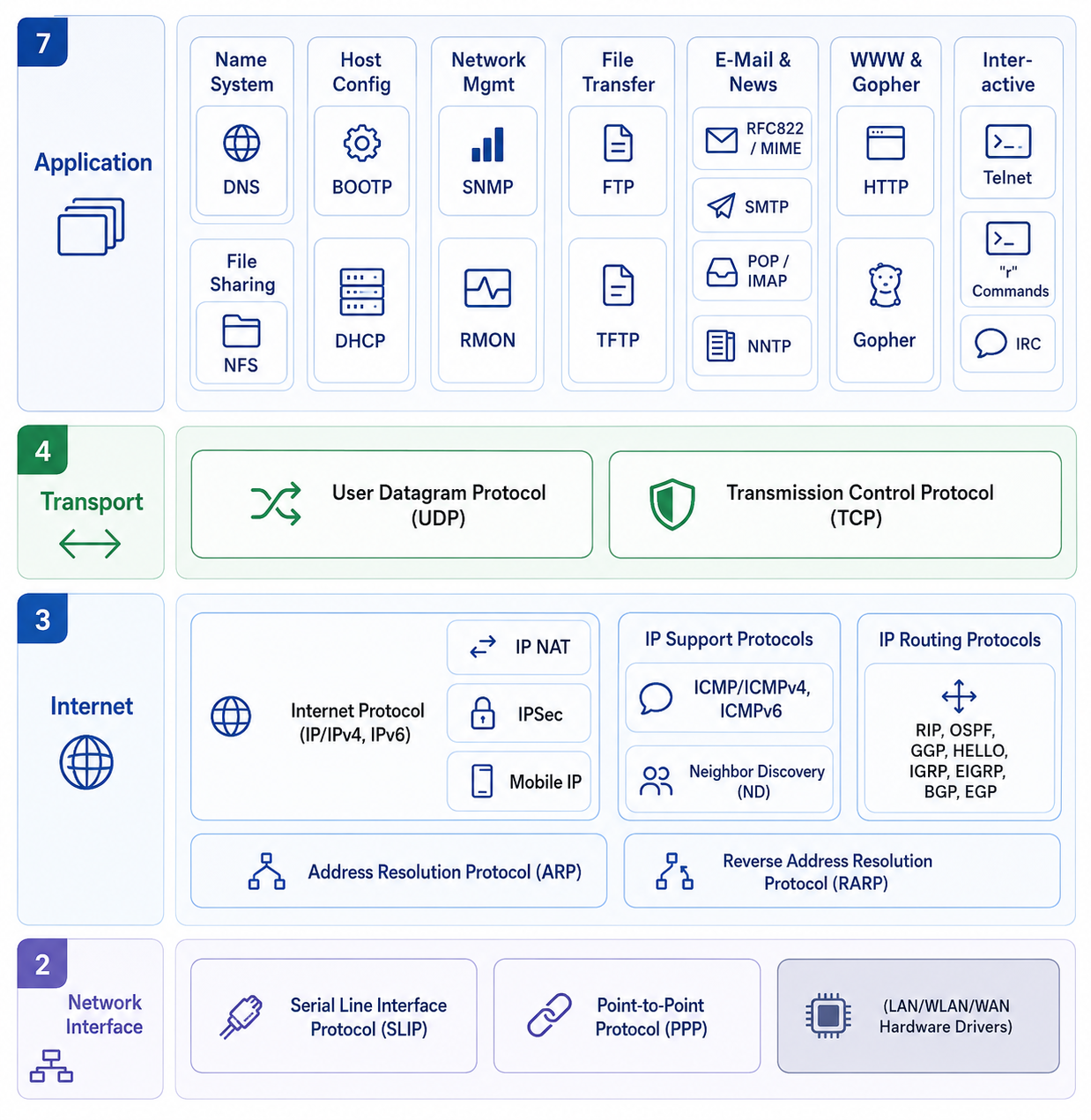
Common TCP/IP protocols by layer.
From study charts · jdepew88 CCNA notes
| Feature | TCP | UDP | |---------|-----|-----| | Connection | Connection-oriented | Connectionless | | Reliability | Yes — ACKs, retransmit | No | | Ordering | Yes | No | | Overhead | Higher (20+ byte header) | Lower (8 byte header) | | Speed | Lower latency tolerance | Lower overhead, faster | | Use cases | Web, SSH, email, file transfer | DNS, DHCP, SNMP, VoIP, QUIC-based apps |
Well-known ports (memorize a handful): 22 SSH, 23 Telnet, 25 SMTP, 53 DNS, 80 HTTP, 443 HTTPS, 161 SNMP.
Step-by-step — TCP handshake and teardown
Three-way handshake (open):
- Client → Server: SYN, seq=100
- Server → Client: SYN-ACK, seq=300, ack=101
- Client → Server: ACK, ack=301
Graceful close (simplified): FIN → ACK → FIN → ACK. Exam questions may ask which flags appear — know SYN, ACK, FIN, RST.
UDP send: No handshake. Host wraps payload in UDP header with src/dst ports and passes to IP immediately.
Commands to know
Client → Server: SYN
Server → Client: SYN-ACK
Client → Server: ACK
Windows
netstat -an | findstr TCP
Linux
ss -tuln
show ip sockets
show control-plane host open-ports
Troubleshooting
| Symptom | Consider | |---------|----------| | Web slow but ping fine | TCP retransmits — congestion, MTU, asymmetric routing | | VoIP choppy | UDP loss/jitter — QoS, buffer, Wi-Fi | | DNS intermittent | UDP 53 blocked; large responses fall back to TCP 53 | | Connection refused | No listener on destination port (RST) | | SYN without SYN-ACK | Firewall, ACL, or service down |
Capture tools (Wireshark) show retransmits and RST flags — invaluable beyond CCNA, but know the theory first.
Exam relevance
DNS often uses UDP for standard queries but TCP for large responses or zone transfers. Do not pick UDP blindly for every DNS question.
Exam scenarios often describe destination port for the service (e.g., client connects to server port 443). Source ports are ephemeral high numbers.
Practice checklist
- List five TCP and five UDP applications from memory
- Draw the three-way handshake with sequence/ack numbers
- Explain why VoIP prefers UDP over TCP
- Identify src vs dst port in a sample
netstatline - Explain what happens when a host sends UDP to a closed port (ICMP port unreachable)
Which protocol is most appropriate for a latency-sensitive voice call?
Which TCP flag completes the three-way handshake?